
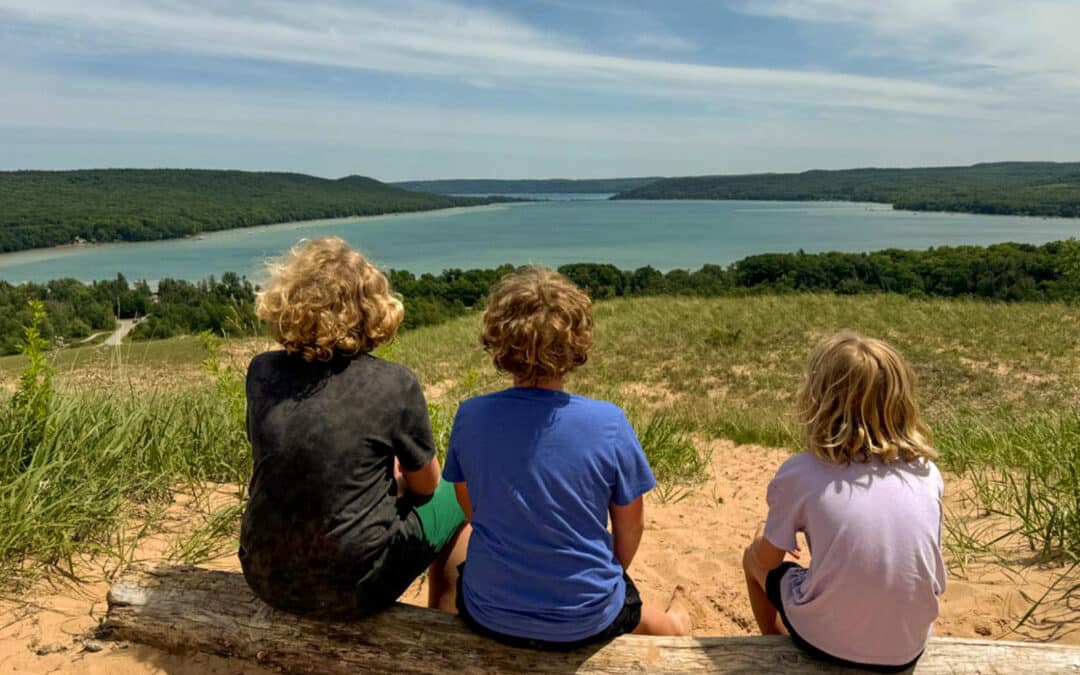
It isn’t there.
The water is two miles west, tucked behind a half-dozen more dunes, and you cannot see a drop of it from the top. The kids are already asking how much farther.
We live ten minutes from that hill. We have watched this scene play out for years, and the truth is the Dune Climb is one of the most rewarding hours in the park if you understand what it actually is, and a long hot disappointment if you don’t. Here is the honest version.

What the Sleeping Bear Dune Climb actually is
The Dune Climb is a wall of open sand on the west side of M-109, about five miles north of Empire. You can see it from the road. There is a parking lot, a picnic area at the base, and then a steep slope of pure sand rising up in front of you. No ticket, no trailhead riddle. You park, and you climb.
The climb is real work. The sand gives back about half of every step, and your legs know it by the time you reach the top. What waits up there is not Lake Michigan. It is Glen Lake, blue and flat behind you, and a long view back over the parking lot you just left.
Then comes the best part, the reason kids beg to come back: the run down. Gravity flips from your enemy to your friend, and you can bound down the face in giant loping steps until your legs forget they were tired. Most kids will do it until they are completely empty.

There are restrooms and the Dune Center at the south end of the picnic area. Bring water even for just the hill. People underestimate sand.

So that is the short version of the Dune Climb: a big hill, a hard climb, a glorious run down, Glen Lake at your back. For a lot of families, that is the whole visit, and it is a good one. The trouble starts when people decide to keep going.

The trek to Lake Michigan: read this before you start
From the top of the Dune Climb, a trail keeps going toward Lake Michigan. This is the Dunes Trail, and it is a different animal entirely.
Round trip, it is 3.5 miles and takes most people three to four hours. The route is marked with blue-topped posts across open sand. The Park Service does not soften it. Their own description warns that “Lake Michigan is not just over that next dune,” and that the trail “has worn out the most experienced hikers.” That is the federal government telling you to slow down.
Here is what those three to four hours are actually like. There is no shade. The sand radiates heat like a parking lot in August. There is no water out there, so whatever you carry is what you get, and on a hot day that means two bottles a person, not one. You climb and descend several more dunes, each one taller than it looked from the last. Cell coverage is unreliable, and phones drain fast hunting for signal.
The gut check is simple. If the first hill, the Dune Climb itself, left you bent over and gasping, do not continue. There are bigger ones ahead, and you have to climb every one of them twice.
Rangers run searches every summer for hikers who went out underprepared and lost track of time or direction. Tell someone your plan before you go, and be honest with yourself about your legs.
Do it right, though, and the payoff is rare. The trail ends at an empty stretch of Lake Michigan beach with no road, no concession stand, and usually no one. You cool off in the water, you catch your breath, and then you turn around and earn your way back.
How (some) locals do it
Here is the part the guidebooks miss. Around here, we did not grow up just “doing the Dune Climb” the way you check a box. We grew up using the dunes. They were the backyard. Our playground. And the best ways through them are point to point, not up and back.
Two routes from childhood, still good today.
The Pierce Stocking drop-off. Get dropped at the Dune Overlook, stop number three on the scenic drive, up on the high plateau. From there you walk back across the open dunes toward the Dune Climb. It runs mostly downhill, the long way home, with the sand and gravity finally on your side instead of against you. You come out at the top of the Dune Climb and get to finish with that famous run down to a waiting car. I did this more than once as a kid, no adults required, and never had trouble. Two things to plan for: you need two cars or a patient driver, and you need two park passes now if you leave a vehicle at each end. Stay on the ridge, and keep a rough sense of which way you are heading.
The Glen Haven beach traverse. Leave one car at the old Life-Saving Station out past Glen Haven village. Drive to the Dune Climb. Hike the trail down to Lake Michigan, then follow the shoreline around Sleeping Bear Point to your second car. It is the whole place in one walk: dune, water, the long curve of the point, the Manitou Islands sitting offshore. Same logistics apply, two passes if you stage two cars. One more rule to know: dogs are not allowed on Sleeping Bear Point from April 15 to August 15, while the piping plovers nest.
Neither of these is a secret exactly. They are just what you do when the dunes are home instead of a stop on a list.
Know before you go
Best time of day. Go early or go late. The first hour after the lot opens and the last hour of light are cooler underfoot, softer to look at, and far less crowded. The dunes at golden hour are worth setting an alarm for, and they roll right into some of the darkest skies in the region once the sun is down. We keep a running list of where to look up in our stargazing notes.
What to bring. Water, more than you think. Real shoes, even if you start barefoot, because the sand gets hot enough to hurt and old dune-grass roots can stab an unprotected foot. Sunscreen and a hat. There is nothing to hide under out there.
Dogs. Not on the Dune Climb. The one dune trail that allows leashed dogs is the Cottonwood Trail on the scenic drive.
 Fees. A vehicle pass is $25 for seven days, or $45 for a Sleeping Bear annual pass that pays for itself in two visits. The Park Service runs ten fee-free days in 2026 if your timing is lucky.
Off season. The Dune Climb does not close in winter. It just becomes a quieter, whiter, stranger version of itself. We wrote about that season here: winter at Sleeping Bear Dunes.
Climb in the morning, recover on the porch
The honest pitch for the Dune Climb is the same as the honest pitch for the trek beyond it: it will empty your legs, and that is the point. You earn the beach, and you earn the slow afternoon that follows.
We are ten minutes from that hill, in the middle of Glen Arbor, with the park wrapped around the village on every side. Climb the dunes in the cool of the morning, come back, and let someone else cook breakfast while your kids sleep off the sand. That is the version we would tell a friend.
When you are ready, come stay with us.
